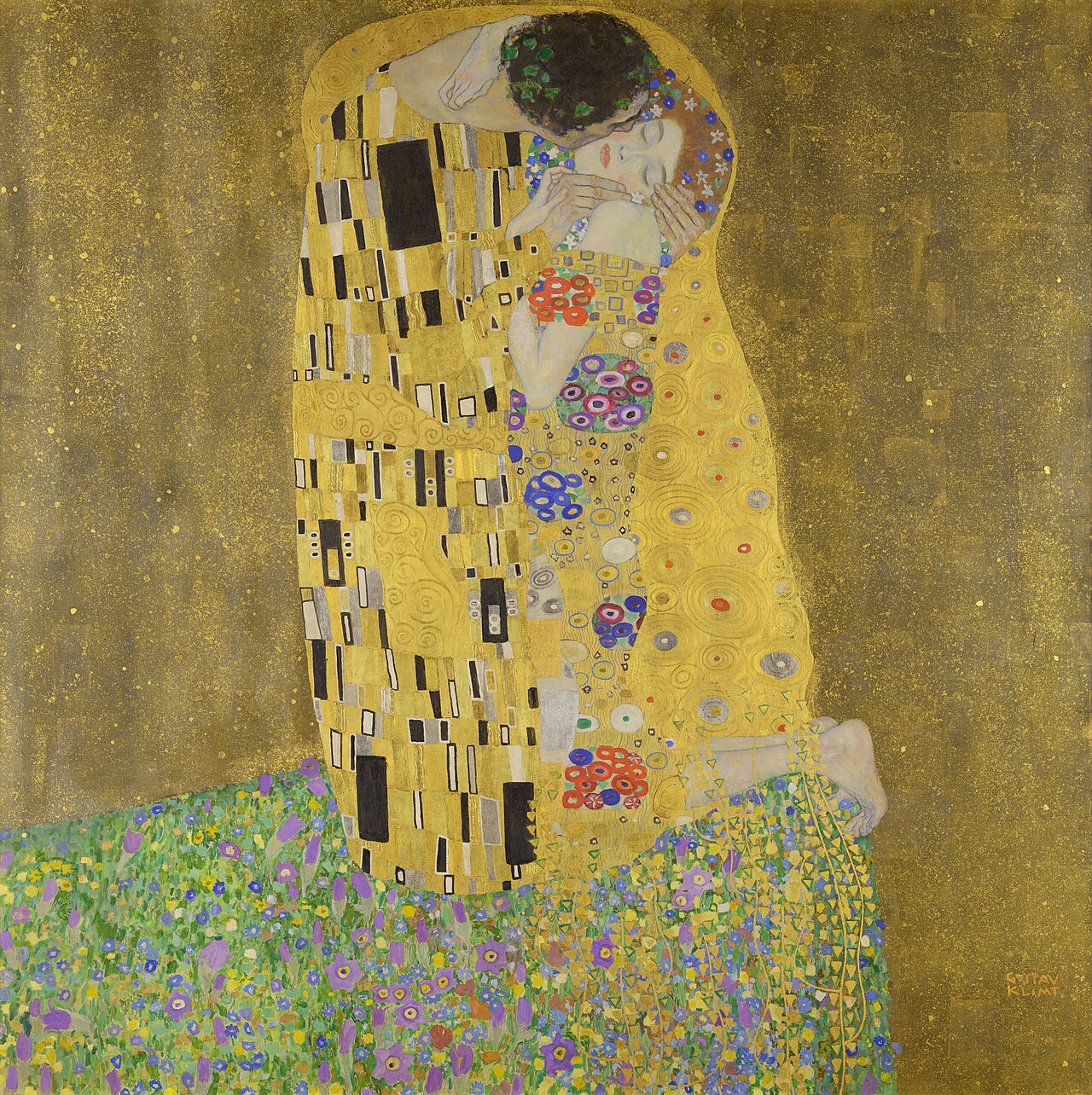
The Kiss

Gustav Klimt

📅 1907-1908 🎨 Art Nouveau / Symbolism 📏 180 × 180 cm 🏛️ Österreichische Galerie Belvedere, Vienna
The Kiss by Gustav Klimt (1907-1908)

At a Glance

🎭

Mood

Intimate, sacred, passionate, dreamlike

🎨

Key Colors

Gold, warm earth tones, pale flesh

📐

Composition

Vertical rectangle, central focal point

✨

Technique

Gold leaf, flat patterns, realistic faces

👨‍🎨

About Gustav Klimt

Gustav Klimt (1862-1918) was an Austrian symbolist painter and one of the most prominent members of the Vienna Secession movement.

Life & Career

Born in Baumgarten, near Vienna, Klimt studied architectural painting at the Vienna School of Arts and Crafts. He became known for his murals, paintings, and sketches, often featuring the female body as a central subject.

Klimt's work is characterized by its unabashed eroticism and its synthesis of high art with decorative motifs. He was profoundly influenced by Byzantine mosaics he saw in Ravenna, Italy, which inspired his famous "Golden Phase" (1899-1910), during which he created "The Kiss."

Artistic Philosophy

Klimt believed in the unity of all arts—painting, architecture, and design. He rejected academic painting traditions, instead embracing symbolism, abstraction, and decorative beauty. His work bridges the gap between 19th-century academic art and 20th-century modernism.

The Vienna Secession

In 1897, Klimt co-founded the Vienna Secession, a group of artists who broke away from conservative art institutions. Their motto: "To every age its art, to every art its freedom." This movement championed individual artistic expression and the integration of art into everyday life.

📜

Historical & Cultural Context

Vienna 1900: Fin de Siècle

Context: Turn-of-the-century Vienna was a hotbed of intellectual and artistic innovation. The Austro-Hungarian Empire was in decline, creating both anxiety and creative freedom.

Cultural Scene: Sigmund Freud was developing psychoanalysis, exploring unconscious desires and sexuality. Gustav Mahler was composing revolutionary symphonies. Arthur Schnitzler was writing about sexual psychology.

1899-1910: Klimt's Golden Phase

Inspiration: After visiting Ravenna, Italy in 1903, Klimt was profoundly influenced by Byzantine mosaics—particularly their use of gold to represent divine light.

Innovation: Klimt applied real gold leaf to canvases, merging ancient religious iconography with modern secular subjects (love, eroticism, nature).

1907-1908: Creation of The Kiss

Peak of Golden Phase: "The Kiss" represents the culmination of Klimt's experiments with gold, pattern, and symbolic imagery.

Reception: Unlike some of Klimt's more controversial works, "The Kiss" was immediately embraced. It was purchased by the Austrian government before completion—a rare honor.

Social Climate

Vienna was experiencing tension between Victorian morality (repression) and emerging modernism (liberation). Freud's work on sexuality was creating controversy. Klimt's sensual paintings challenged conservative norms.

Artistic Movements

Art Nouveau emphasized organic forms, decorative beauty, and the integration of art into daily life. Symbolism prioritized emotion and idea over realistic representation. Klimt synthesized both.

Philosophical Influences

Nietzsche's philosophy of life affirmation, Schopenhauer's exploration of desire, and Eastern philosophy's focus on unity influenced Klimt's themes of love, death, and transcendence.

🔍

Subject Matter: What's Happening

The Literal Description

Two figures—a man and a woman—embrace on a flower-covered patch of ground at what appears to be the edge of a cliff or precipice. The man, standing, leans down to kiss the woman on the cheek. The woman kneels, her face tilted upward, eyes closed, hands gently placed on his.

Both figures are wrapped in elaborately decorated golden robes that blend together, making it difficult to distinguish where one person ends and the other begins. The man's robe features rectangular and straight-line patterns; the woman's robe displays circular, oval, and floral patterns.

Key Elements

  • The Embrace: The man cradles the woman's face with both hands. The gesture is protective and tender.
  • Body Language: The man is active (standing, leaning); the woman is receptive (kneeling, eyes closed, surrendering to the moment).
  • The Setting: A field of wildflowers extends below them. The background is completely gold—no landscape, no sky, creating a timeless, placeless quality.
  • The Edge: They stand at what appears to be a precipice. The flower field ends abruptly, suggesting both beauty and danger.

What We DON'T See

Equally important is what Klimt chose to exclude:

  • No realistic background or setting (just gold)
  • No feet visible (figures seem to float)
  • No indication of time or place (universal moment)
  • No narrative context (we don't know who these people are or what happened before/after)

This absence of narrative detail is intentional—Klimt isn't telling a specific story. He's capturing the ESSENCE of romantic intimacy itself.

📐

Composition: The Invisible Structure

Primary Compositional Shape: The Vertical Rectangle

The embracing lovers form a unified vertical rectangular shape that rises from the flower field. This is the painting's fundamental structure.

Why This Matters:

  • Stability: Vertical forms feel grounded and stable (unlike diagonals, which create tension)
  • Unity: Two separate bodies read as ONE shape—visual metaphor for "two become one"
  • Monumentality: The vertical emphasis makes them feel important, significant, almost architectural
  • Elevation: Vertical suggests upward movement, transcendence, spiritual reaching

Focal Point Strategy

Your eye goes to the woman's face first. Why?

  • It's the lightest value in the painting (contrast attracts eye)
  • It's centrally placed
  • It's the only fully visible face (the man's face is mostly hidden)
  • Her expression is readable—peaceful, surrendered, intimate

Eye Movement Pattern

  1. Enter at the woman's face (focal point—lightest area)
  2. Travel up to the man's tilted head (diagonal created by his neck)
  3. Follow the golden robes downward (the rectangular shape)
  4. Settle on the flower field below (horizontal ground plane)
  5. Return to the woman's face (completing the circuit)

This creates a circular reading pattern—your eye keeps moving, just as the lovers are caught in an eternal moment of intimacy.

Balance & Symmetry

The composition is roughly symmetrical vertically (left-right balance) but asymmetrical in detail:

  • The unified shape is centered on the canvas
  • But the man leans left; the woman's face tilts right
  • This creates dynamic balance—stable overall but with internal movement

🎬 For Filmmakers:

Klimt's vertical composition is why romantic scenes often use medium shots framing two people as a single silhouette. Examples:

  • Titanic - Jack and Rose at the ship's bow
  • The Notebook - Rain kiss scene
  • La La Land - Observatory dance

When you want to show "these two are one unit," compose them as a unified shape with a vertical emphasis.

🎨

Color & Light: Emotional Temperature

The Overwhelming Gold

Gold dominates "The Kiss" so completely that it becomes the painting's essential character. This isn't decorative—it's symbolic.

🌟 Gold Symbolism

  • Divine Light: In Christian iconography, gold backgrounds represent heaven, God's presence
  • Preciousness: Gold is rare, valuable—love itself is precious
  • Eternity: Gold doesn't tarnish or fade—suggesting timeless love
  • Sacredness: Elevates the secular (romantic love) to sacred status

🔥 Warm Temperature

The entire palette is WARM—no cool blues or greens.

  • Gold, amber, ochre (warm yellows)
  • Burnt sienna, rust (warm browns/reds)
  • Pale peach (flesh tones)

Effect: Creates intimacy, passion, emotional heat. Warm colors feel close and enveloping.

Contrast Strategy

Soft Flesh vs. Hard Gold

The vulnerable humanity of pale skin contrasts with the protective, eternal quality of gold. Suggests fragility protected by something precious and enduring.

Ornate Patterns vs. Simple Faces

The decorative complexity of the robes makes the simple, peaceful faces feel even more intimate and human. The visual noise quiets when you reach their faces.

Flat Gold vs. Dimensional Flowers

The background gold is completely flat; the flower field has subtle depth. This grounds the lovers in nature while surrounding them with the divine.

Light Source & Quality

Klimt doesn't use realistic lighting (no shadows cast, no directional light source). Instead:

  • The gold ITSELF seems to glow from within
  • This creates a dreamlike, ethereal quality—we're not in the real world
  • The lightest areas (faces, hands) appear luminous against the gold
  • Suggests the lovers ARE the light source—they illuminate each other

🎬 For Filmmakers: Color Grading for Intimacy

When cinematographers want romance or intimacy, they use Klimt's strategy:

  • Warm color temperature: Push toward amber/gold in grading
  • Soft, diffused light: No harsh shadows
  • Subjects as light sources: Light the actors' faces to make them luminous

Examples: Call Me By Your Name (golden Italian summer), Her (warm amber interiors), The Grand Budapest Hotel (pastel warmth)

🖌️

Texture & Technique: How It's Made

Revolutionary Materials: Real Gold Leaf

Klimt didn't paint gold—he applied actual gold leaf to the canvas. This was unprecedented in modern secular painting.

What is Gold Leaf?

Extremely thin sheets of real gold (22-24 karat) hammered to about 0.0001mm thick. It's applied with adhesive and burnished to create a reflective, shimmering surface.

Why Use It?

  • Creates actual reflective light (not just painted illusion)
  • Surface changes depending on viewer's position and lighting
  • Makes the painting itself a precious object (not just an image)
  • References Byzantine religious art (connecting secular love to sacred tradition)

The Flat vs. Modeled Dichotomy

FLAT (The Robes)

  • Geometric patterns painted as completely flat shapes
  • No shading, no dimensionality
  • Looks almost like decorative wallpaper or textile design
  • Byzantine mosaic influence—purely symbolic space

MODELED (Faces & Hands)

  • Realistic modeling with shadows and highlights
  • Three-dimensional forms
  • Western painting tradition—illusionistic space
  • Draws your eye (dimensionality attracts attention)

What this achieves: Klimt bridges two artistic worlds—Eastern/Byzantine (flat, symbolic, decorative) and Western/Renaissance (dimensional, realistic, illusionistic). The painting exists in both traditions simultaneously.

Pattern & Repetition

The Man's Patterns:

Rectangles, straight lines, geometric blocks—traditionally masculine symbols (rigid, rational, structural)

The Woman's Patterns:

Circles, ovals, flowers—traditionally feminine symbols (curved, organic, flowing)

Where They Meet:

The patterns MERGE at the point of embrace—visual symbol of union, complementarity, masculine and feminine becoming one.

🎬 For Filmmakers: Depth of Field as Texture Control

Klimt's flat patterns vs. dimensional faces = shallow depth of field in cinematography:

  • Blur the background (patterns) to flatten it visually
  • Keep the subject (faces) in sharp focus with dimensionality
  • This creates visual hierarchy—we know what matters

Examples: Portrait cinematography in The Grand Budapest Hotel, Marie Antoinette, Anna Karenina

🔮

Symbolism & Meaning

The Layers of Symbolic Meaning

"The Kiss" operates on multiple symbolic levels simultaneously. Here's how to decode them:

1. The Patterns: Gender & Unity

Man's Rectangles/Straight Lines:

  • Traditionally masculine—rigid, geometric, rational
  • Phallic symbolism (vertical, penetrating forms)
  • Represents structure, order, the masculine principle

Woman's Circles/Flowers:

  • Traditionally feminine—curved, organic, flowing
  • Womb symbolism (circular, containing forms)
  • Represents nature, fertility, the feminine principle

Interpretation: Klimt shows masculine and feminine as complementary opposites that unite in the embrace. The patterns MERGE where their bodies meet—visual symbol of sexual/spiritual union. This isn't about erasing difference; it's about difference becoming harmony.

2. The Flower Field: Nature & Fertility

Wildflowers represent:

  • Natural beauty and growth
  • Fertility and life force
  • The organic world (in contrast to the geometric patterns)
  • Renewal and spring (traditional associations)

But they stand ABOVE the flowers: Love elevates us above the purely natural/biological. It's not just instinct—it's transcendence.

3. The Precipice: Beauty & Danger

The flower field ends abruptly—they're at an edge, possibly a cliff.

Multiple Interpretations:

  • Love makes us vulnerable (standing at the edge of loss)
  • The ecstasy of love borders on danger, dissolution, loss of self
  • Beautiful moments are fleeting (the edge represents time's passage)
  • Surrender and fall—giving yourself over to another is risky

Klimt suggests love is both beautiful and dangerous—we risk everything for these moments.

4. Gold Itself: Sacred Love

In Christian iconography, gold backgrounds represent:

  • Divine light (the presence of God)
  • Heaven, the eternal realm
  • Holiness and spiritual transcendence

Klimt's Innovation: By wrapping EROTIC/ROMANTIC love in gold, he elevates it to the status of religious experience. The painting argues: Romantic love IS a form of the sacred. Intimacy IS spiritual experience.

This was radical in 1908—suggesting physical/romantic love has the same spiritual significance as religious devotion.

5. Body Language: Power & Surrender

The Man: Standing, leaning down, cradling her face, active role

The Woman: Kneeling, eyes closed, hands gently touching, receptive role

Historical Reading (1908): Reflects gender roles of the era—man as pursuer/protector, woman as receiver/nurturer.

Modern Reading: Can be interpreted as unequal power dynamics (he stands above her). However, her peaceful expression and the merging of their robes suggests mutual vulnerability.

Alternative Interpretation: Both are surrendering—he to the act of giving; she to the act of receiving. Both are vulnerable in different ways.

There's no single "correct" reading. Your interpretation is valid if you can support it with visual evidence.

✨

Putting It All Together

What "The Kiss" Means (Synthesis)

After analyzing composition, color, technique, and symbolism, here's the holistic interpretation:

Gustav Klimt painted "The Kiss" at a cultural moment when Western society was simultaneously repressed (Victorian morality) and awakening (Freudian psychology, modernism). The painting bridges ancient (Byzantine gold, religious iconography) and modern (abstract patterns, secular subject matter).

The Central Argument: Romantic and erotic love IS a form of transcendence, worthy of the same reverence as religious experience. By wrapping physical intimacy in gold—the traditional symbol of the divine—Klimt elevates human love to sacred status.

The lovers are enclosed in their own world (the golden rectangular embrace), protected from the void (the precipice), lost in a moment that feels eternal despite being fleeting. The masculine and feminine patterns merging symbolize unity without loss of individual identity—difference coming together, not erasing difference.

The Emotional Truth: "The Kiss" captures not the physical action of kissing but the FEELING of being completely absorbed in another person—the moment of perfect intimacy where nothing else exists. It's the suspended moment right before or right after the kiss, when time stops and two people become one world unto themselves.

The gold suggests this moment is precious, sacred, worth preserving forever. The flowers suggest it's natural, organic, part of the life force. The precipice suggests it's also dangerous, vulnerable, fleeting. Beauty and danger coexist.

Your Turn: Personal Interpretation

After going through the analysis, ask yourself:

  • What does "The Kiss" mean to YOU personally?
  • Does it remind you of a specific experience or feeling?
  • Do you agree with Klimt's elevation of romantic love to sacred status?
  • How do you read the gender dynamics?
  • What emotion does the painting evoke now, after deep analysis?

Remember: Your interpretation is valid if you can support it with visual evidence from the painting. There's no single "correct" meaning—art is a conversation between artist and viewer.

🎬

For Filmmakers: How to Steal Like An Artist

Translating "The Kiss" to Film

Here's how Klimt's visual strategies translate directly to cinematography and filmmaking:

Klimt's Technique Film Equivalent When to Use It
Warm gold color palette Color grading toward amber/gold in post-production Romantic scenes, intimate moments, nostalgic flashbacks
Vertical composition (two as one) Medium shot framing lovers as unified silhouette Showing romantic unity, "these two are one," connection
Flat patterns vs. dimensional faces Shallow depth of field (blur background, focus on faces) Creating visual hierarchy, directing attention, intimacy
Soft, glowing light (no harsh shadows) Diffused lighting, bounce light, soft boxes Romantic moments, dreamlike sequences, tenderness
Subjects as light sources Light actors' faces to make them luminous Making characters feel precious, important, focal
Symbolic patterns (masculine/feminine) Visual motifs in costume, production design Showing character traits, internal states visually
Timeless, placeless background Minimal backgrounds, isolated figures, abstract settings Universal emotions, focus on relationship over setting

Films That Use "The Kiss" Aesthetic

The Grand Budapest Hotel (2014)

Director: Wes Anderson | DP: Robert Yeoman

Klimt Influence: Ornate patterns, warm color palette, decorative maximalism meets emotional intimacy. The hotel interiors use Klimt-like gold and pattern motifs.

Marie Antoinette (2006)

Director: Sofia Coppola | DP: Lance Acord

Klimt Influence: Lush, warm color grading; golden light; focus on texture and decoration; intimate moments amid visual splendor.

Anna Karenina (2012)

Director: Joe Wright | DP: Seamus McGarvey

Klimt Influence: Golden ballroom scenes, ornate costumes, theatrical staging, lovers isolated in decorative environments.

Call Me By Your Name (2017)

Director: Luca Guadagnino | DP: Sayombhu Mukdeeprom

Klimt Influence: Golden Italian summer light, warm color temperature, intimate framing, romance as transcendent experience.

If You Were Filming "The Kiss" as a Scene

Camera Choice

Sensor with good color science for warm tones (ARRI, RED Komodo)

Lens

85mm or 100mm (medium telephoto) at f/2.8 or wider for shallow DOF

Framing

Medium shot, vertical composition, two actors as one unified shape

Lighting

Soft key from above (creating gentle wrap), bounce light to fill, no harsh shadows, warm temperature (3200K or warmer)

Color Grading

Push toward amber/gold in midtones, desaturate cool tones, keep skin tones natural, add warm glow

Production Design

Ornate, patterned fabrics; gold/bronze metallic elements; minimal background (keep focus on actors)

Movement

Slow push-in on the embrace, ending on woman's face—mirroring how Klimt draws the viewer's eye

Practice Exercise

Now that you've gone through the complete analysis of "The Kiss," apply what you've learned:

1

Watch a Film Scene

Watch the ballroom scene from Anna Karenina (2012) or a romantic scene from The Grand Budapest Hotel.

2

Identify Klimt Elements

Look for: warm color palette, ornate patterns, vertical framing of lovers, soft lighting, shallow depth of field.

3

Analyze the Connection

Write 2-3 paragraphs explaining how the filmmakers "stole" from Klimt. What specific techniques did they borrow? What emotion were they trying to create?

Explore More Paintings